Designing Gestural Liberatory Vessels:
A Creative Library as Pedagogical Intervention
By Dina Benbrahim
Humans are messy, and we have shaped this world in our image. Oppression surrounds every layer of society yet hope exists in the smallest corners. This article invites you into a small corner of hope—a space dedicated to dreaming and doing otherwise through design pedagogy.
Augusta Baker and the Politics of Representation
In 1937, Augusta Baker walked through the doors of The New York Public Library’s 135th Street Branch and identified a critical gap in children’s literature: the shelves held virtually no books portraying Black children as heroes, dreamers, or even everyday kids having adventures. Hired as a children’s librarian by the NYPL, Baker launched a transformative initiative that would reshape the landscape of children’s publishing. She curated collections that celebrated Black experiences and personally encouraged publishers and writers to tell stories reflecting the nuances of diverse communities (New York Public Library, 2021).
Baker’s work demonstrates how cultural institutions can serve as sites of resistance and reimagination. Her legacy resonates with what Jarvis Givens terms “fugitive pedagogy” in his 2021 book Fugitive Pedagogy: Carter G. Woodson and the Art of Black Teaching. Givens documents how Black educators from the era of enslavement through Jim Crow developed covert instructional strategies and creative responses to white opposition, passing down an educational heritage rooted in resistance and self-determination. This tradition of teaching as subversive practice — where educators like Carter G. Woodson fought against the “mis-education” of Black students — provides historical grounding for contemporary efforts to center marginalized voices in educational spaces.
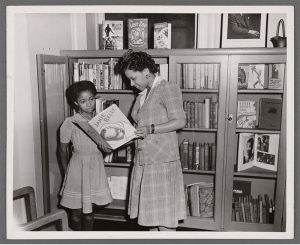
Image:Librarian Augusta Baker showing a copy of Ellen Tarry’s “Janie Belle” to a young girl at the library, NYPL Digital Collections, Accessed December 19, 2025
From Dream to Praxis: Building Alternative Infrastructures
The Feminist Bookstore Movement
Since 2010, I have envisioned creating a bookstore centering non-dominant voices. The romanticized image of a cozy bookstore filled with sandalwood candles and community dialogues is compelling, yet my initial market research across multiple environments revealed the economic reality: such a venture would require substantial financial investment with slow returns. This constraint led me to refocus on my existing capacity: design education.
This vision draws inspiration from the feminist bookstore movement of the 1970s-1990s, which Kristen Hogan chronicles in The Feminist Bookstore Movement: Lesbian Antiracism and Feminist Accountability (2016). Feminist bookstores operated as more than shops. They functioned as community hubs, sites of political organizing, and critical infrastructures for marginalized knowledge production. These bookstores demonstrated how physical spaces dedicated to centering non-dominant voices could catalyze broader cultural and political transformation, even as they grappled with their own internal challenges around race, class, and accessibility.
The creative library project also engages with contemporary scholarship on intersectionality in library and information science. Rose L. Chou and Annie Pho’s edited collection Pushing the Margins: Women of Color and Intersectionality in LIS (2018) documents how libraries, despite idealizing themselves as egalitarian institutions, often perpetuate societal racism, sexism, and oppression. This book challenges the myth of library neutrality and calls for actively anti-racist, feminist approaches to knowledge infrastructure.
Education As The Framework to Question
Academia continues to privilege dominant ideas crafted by and for the ruling class, as Marx and Engels articulated in their analysis of ideology and power. However, this same institutional space presents opportunities to dismantle these practices and challenge what Paolo Freire termed the “banking model of education,” where knowledge is deposited into passive students rather than co-created through dialogue and critical consciousness (Freire 1970). Freire’s work builds on earlier decolonial thinkers, particularly Frantz Fanon, whose The Wretched of the Earth (1961) analyzed how colonialism operates not only through physical violence but through the colonization of consciousness itself. Fanon argued that true decolonization requires revolutionary transformation of both institutions and minds which is a process of “unlearning” colonial knowledge systems and reclaiming indigenous ways of knowing.
Moroccan revolutionary and educator Mehdi Ben Barka articulated this connection between education and liberation most directly, declaring that “education isn’t a fundamental question, it’s THE fundamental question” (Ben Barka, 1962). A mathematics teacher who co-founded Morocco’s independence movement, Ben Barka understood that political independence without educational transformation would leave colonial structures of knowledge intact. He argued that post-independence societies must address not only the exploitation of the colonial period but also internalized systems of oppression. This is what he called “the exploitation of the Moroccan man by the Moroccan man.” His vision of education as the foundation for both national and individual liberation, developed through his work with the Tricontinental Conference connecting African, Asian, and Latin American liberation movements, continues to inspire my pedagogical practices today.
Engaged Pedagogy
bell hooks extends Freire’s framework in Teaching to Transgress: Education as the Practice of Freedom (1994), arguing that the classroom can be a site of resistance and liberation when educators commit to engaged pedagogy. hooks emphasizes that teaching must be a practice that respects and cares for the souls of students, recognizing education as a fundamentally communal act. In Teaching Community: A Pedagogy of Hope (2003), she further articulates how creating beloved community in educational spaces requires vulnerability, honesty, and a willingness to challenge systems of domination.
Sara Ababneh, a Jordanian-Palestinian scholar, extends these frameworks into the Arab context through her work on decolonial-connected feminist pedagogy. In her 2025 essay “The Personal Is Political: Teaching Decolonial-Connected Feminist Middle East Politics through Self-Reflexivity,” Ababneh argues that teaching about the SWANA region is inherently political work that requires challenging Orientalist frameworks embedded in Western education. She advocates for standpoint feminist theory, recognizing that “the personal is political and international,” and emphasizes emotional and embodied learning as central to decolonial pedagogy (Ababneh, 2025).
Egyptian feminist physician, psychiatrist, and writer Nawal El Saadawi (1931–2021) provides another crucial framework for understanding education as liberation. El Saadawi argued that patriarchy, capitalism, and imperialism constitute intertwined systems oppressing women and preventing their full potential. In The Hidden Face of Eve: Women in the Arab World (1980), she linked questions of gender and sexuality to politics, economics, and culture, insisting that medicine cannot be separated from these forces. Her concept of “dissidence as creativity” posits that conformity stifles the creative powers inherent in human beings, while dissidence—understood in Arabic as struggle—connects directly to the effort to create and bring something new into the world. For El Saadawi, one cannot be dissident without being creative, and true education must involve “decolonizing the mind, undoing the damage of education, of fear towards the media, of religion” (El Saadawi, 1980). Her founding of the Arab Women’s Solidarity Association (AWSA) in 1985 created what she envisioned as a site of knowledge-building and dissemination, operating as an epicenter of Arab feminism during a time of increasing religious conservatism.
As Sara Carpenter and Shahrzad Mojab observe in Revolutionary Learning: Marxism, Feminism and Knowledge, “critical education and critical theorizations of learning have long contended with the allegation of dogmatism” (Carpenter and Mojab, 2017, 17). This tension between critique and prescription remains central to liberatory pedagogical practice.
The Creative Library: A Pedagogical Intervention
An Alternative Institution
We learn in contact with the environments we inhabit. What happens when these environments incorporate boundary-breaking approaches? In response to current political constraints and my dreamed possibilities, I expanded on a creative library by centering QTBIPOC voices within Design Center, a space that was founded by Professor and activist Edvin Yegir in the Art + Art History Department at the University of Connecticut. As my friend and colleague, Professor Mark Zurolo recalls, Edvin “believed in design as a tool for positive change and growth, and used it to forge design committed to promoting social justice. His classrooms were collaborations; communities in which students from across the years have commented on how overwhelmingly positive the environment he created was; how he critiqued with the kindest grace.” I hope this work honors him.
Like the feminist bookstores that Hogan documents, this library aspires to be an “alternative institution” that challenges mainstream knowledge systems while remaining accountable to the communities it serves. It operates as a space for teaching, learning, and self-teaching—recognizing that these modes are not discrete but interwoven and inform one another. The feminist bookstore movement’s commitment to what Hogan terms “lesbian antiracism,” being an ongoing, imperfect practice of working across difference, informs the library’s framework of continuous learning and accountability.
This work builds on what Gloria Ladson-Billings theorizes as “culturally relevant pedagogy.” It creates the possibility to teach while empowering students to maintain cultural integrity as they reach their academic goals (Ladson-Billings, 1995). Ladson-Billings identifies three essential components: fostering student learning and academic success, developing students’ cultural competence to support diverse identities, and nurturing students’ critical consciousness to recognize and critique societal inequities. The creative library operationalizes these principles by providing resources that reflect students’ lived experiences while simultaneously challenging them to analyze systems of power. Evidence of the library’s impact emerges through student encounters. A graduating senior recently told me he wished the library had existed during his undergraduate years. Students increasingly reference the collection when seeking books for personal reading. When one student shared that they had requested several titles as birthday gifts from their parents, I was struck by this simple desire—not for consumer goods, but for books that spoke to their experience and curiosity.
Feminist Pedagogy as Disruption
Given the increasingly conservative political climate, Design Center functions as what I call a “gestural liberatory vessel” for critical and educational conversations that exist outside perceived norms and limitations. This space facilitates the co-creation of a micro-culture where participants can debate, think, exhibit, unlearn, voice, exchange, archive, care, transgress, fail, resist, dream, interrupt, interrogate, learn, experience, reform, design, write, and act.
The space operates with an explicit commitment to articulate consciousness and co-create accessible knowledge. This commitment necessarily involves refusal; a strategic saying “no” to extractive practices and oppressive systems. Sara Ahmed, in Living a Feminist Life (2017), theorizes the feminist killjoy as one who refuses to participate in oppressive happiness and instead creates alternative worlds through her refusal. Ahmed writes about how feminist work involves both critique and the labor of creating new paths, what she calls “feminist snap.” It is the moment when we refuse to go along with what diminishes us. When I first started building this library at another institution, I called it the Snap, Snap, Sizzle library.
This practice of refusal connects to what Bettina Love calls “abolitionist teaching” in her 2019 book We Want to Do More Than Survive. Love argues that the US educational system constitutes an “educational survival complex” that profits from the suffering of students of color, offering only survival tactics rather than pathways to thriving. Abolitionist teaching, she contends, requires approaching education with the imagination, determination, boldness, and urgency of historical abolitionists. This means teaching students about racial violence and oppression while equipping them to make sustainable change through radical civic initiatives. Love’s concept of “freedom dreaming” as imagining worlds that center people’s full humanity and represent collective resistance, animates the creative library’s vision.
Tracy Penny Light, Jane Nicholas, and Renee Bondy’s Feminist Pedagogy in Higher Education (2015) also provide a framework for understanding how feminist teaching practices disrupt traditional power dynamics in the classroom. They argue that feminist pedagogy is characterized by collaborative learning, reflexivity, and attention to power relations. These principles directly inform the creative library’s approach to knowledge-sharing and community-building.
Design as Liberation: Daily Practices
A Pedagogy of Curiosity
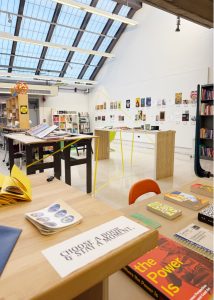
Given that design either liberates or oppresses, nourishing students’ consciousness is, in and of itself, an act of refusal today. Sometimes, our books are sitting in shelves. Sometimes, I rearrange them. Sometimes, I lay a few on tables to create the atmosphere of a reading room. Sometimes, I start or end class by reading a passage from one of these books. This semester my students co-created an exhibition on overlooked design narratives in the design canon, and we pulled relevant books to enrich the exhibit. A student from that class wrote to me: “thanks for drilling design history and sources to learn more about design history into our brains, I definitely would not want to go out into the world without knowing a lot of the context that we learned about.” Drilling is a fascinating word. It implies making space for something we value.
I regularly ask my students: When was the last time you paused to explore with curiosity? I invite them to select a book and imagine themselves hungry for ideas, to feed themselves intellectually and emotionally, then share what they see and feel with their peers. This approach embodies what hooks describes as engaged pedagogy, a practice that emphasizes mutual growth and recognizes the classroom as a dynamic space where everyone contributes to knowledge production. hooks insists that excitement about learning can be present even when confronting difficult truths, and that education should never be reduced to mere information transfer but must touch the emotional and spiritual dimensions of human experience. This pedagogical approach also aligns with what Selma Jonkers and Jeanny Kaethoven describe in No School Manifesto: “Your environment matters. The space you are given, gives shape. The space you take, is defining. Take the space to dream, to reinvent yourself. Have the courage” (Ouwens, Camuti, and Steves 2020, 159).
Additionally, in an era dominated by screens, this creative library offers a naturally lit environment that evokes James Turrell’s atmospheric interventions with light and space. When visitors close their eyes, they experience openness; when they open them again, they find themselves surrounded by books, materials, and a creative community designed to ignite curiosity, encourage contemplation, and foster discussion.
Increasing Access
As Offshore Studio articulates in Graphic design is… not innocent: “Every visual expression comes with its politics and it’s up to us whether we want to use these inherent politics blindly or want to accept our responsibility in questioning and challenging them” (Offshore Studio 2022, 161). This assertion underscores the ethical imperative for designers to recognize their work as inherently political and to make conscious choices about whose interests their practice serves. Access to resources that center minoritized voices and critical perspectives cultivates deeper thinking. The creative library serves not merely as a collection of texts on art and design centering QTBIPOC voices, but as an intervention in the spatial politics of design education.
Finally, Design Center is a modular classroom. Everything is mobile, including our books, which is an approach recognizing that access is not only about having resources available but about reducing barriers to engagement. By bringing books directly into classrooms, the creative library intervenes in potential spatial inequities, ensuring that students encounter diverse, affirming texts at the point of need rather than requiring them to seek out resources that may be geographically, economically, or culturally inaccessible. A student shared in an end-of-semester evaluation: “having the library full of different categories of design history and designers was incredibly an honor and opportunity. I really believe having these books is a privilege as a design student.” As Frans Oort observes: “Even when you discover something brilliant by accident, you are still brilliant because you have brought yourself in the position to encounter this brilliant thing” (quoted in Ouwens, Camuti, and Steves 2020, 203). This insight emphasizes the importance of creating conditions for serendipitous discovery and what I call “creating room for wandering in classrooms.”
A Continuous Practice and Invitation
The creative library at Design Center represents a modest but meaningful intervention in design pedagogy. By centering QTBIPOC voices, challenging banking models of education, and creating space for critical dialogue, this project participates in the ongoing work of building alternative infrastructures for learning and practice.
Drawing lessons from the feminist bookstore movement and the tradition of fugitive pedagogy that Givens chronicles, I recognize that creating liberatory spaces requires more than good intentions. It demands continuous accountability, willingness to confront internal contradictions, and commitment to working across difference. As Hogan’s research reveals, even spaces founded on principles of inclusion and justice must constantly interrogate their own practices and power dynamics. The creative library embraces this imperative for reflexivity as central to its mission.
Thiswork of building a beloved community, as hooks envisions it, requires ongoing labor and care. It means creating spaces where, as Ahmed might say, we can “live feminist lives” being lives that refuse to reproduce harm and instead clear paths for others to follow. The creative library attempts to be such a path, cleared through the daily practice of feminist pedagogy that Light, Nicholas, and Bondy describe: collaborative, reflexive, and attentive to power. It also embodies Love’s call for freedom dreaming and abolitionist teaching—moving beyond survival toward educational freedom and collective liberation. By integrating culturally relevant pedagogy as Ladson-Billings articulates it, the creative library supports students in maintaining cultural integrity while developing critical consciousness about systems of oppression.
In a discipline where every visual expression carries political implications, designers must cultivate consciousness about whose stories are told, whose perspectives are centered, and whose futures are imagined. The creative library offers one model for how educational spaces can nurture this critical awareness while fostering the courage to dream and design otherwise. If this resonates, start building your own creative library for your community. It might look entirely different from ours, and perhaps it should. In the meantime, come see what we’re creating. The work continues, and you’re invited.
References
Ababneh, Sara. 2025. “The Personal Is Political: Teaching Decolonial-Connected Feminist Middle East Politics through Self-Reflexivity.” Daedalus 154, no. 1: 180–192.
Ahmed, Sara. 2017. Living a Feminist Life. Durham, NC: Duke University Press.
Ben Barka, Mehdi. 1962. “Option Révolutionnaire au Maroc.” In Écrits Politiques 1957-1965, 127–148. Paris: Syllepse, 1999.
Carpenter, Sara, and Shahrzad Mojab. 2017. Revolutionary Learning: Marxism, Feminism, and Knowledge. London: Pluto Press.
Chou, Rose L., and Annie Pho, eds. 2018. Pushing the Margins: Women of Color and Intersectionality in LIS. Sacramento, CA: Library Juice Press.
El Saadawi, Nawal. 1980. The Hidden Face of Eve: Women in the Arab World. Translated by Sherif Hetata. London: Zed Press.
Fanon, Frantz. 1961. The Wretched of the Earth. Translated by Richard Philcox. New York: Grove Press, 2004.
Freire, Paolo. 1970. Pedagogy of the Oppressed. New York: Continuum.
Givens, Jarvis R. 2021. Fugitive Pedagogy: Carter G. Woodson and the Art of Black Teaching. Cambridge, MA: Harvard University Press.
Hogan, Kristen. 2016. The Feminist Bookstore Movement: Lesbian Antiracism and Feminist Accountability. Durham, NC: Duke University Press.
hooks, bell. 1994. Teaching to Transgress: Education as the Practice of Freedom. New York: Routledge.
hooks, bell. 2003. Teaching Community: A Pedagogy of Hope. New York: Routledge.
Ladson-Billings, Gloria. 1995. “Toward a Theory of Culturally Relevant Pedagogy.” American Educational Research Journal 32, no. 3: 465–491.
Light, Tracy Penny, Jane Nicholas, and Renee Bondy, eds. 2015. Feminist Pedagogy in Higher Education: Critical Theory and Practice. Waterloo, ON: Wilfrid Laurier University Press.
Love, Bettina L. 2019. We Want to Do More Than Survive: Abolitionist Teaching and the Pursuit of Educational Freedom. Boston: Beacon Press.
Neuman, Susan B., and Naomi Moland. 2016. “Book Deserts: The Consequences of Income Segregation on Children’s Access to Print.” Urban Education 51, no. 5: 548–576.
New York Public Library. 2021. “NYPL’s Augusta Braxton Baker: Fighting Stereotypes and Developing Diverse Collections.” March 1, 2021. https://www.nypl.org/blog/2021/03/01/nypls-augusta-braxton-baker-fighting-stereotypes-and-developing-diverse-collections.
Offshore Studio. 2022. “Graphic Design as a Narrative Tool.” In Graphic design is… not innocent, edited by Ingo Offermanss, 161. Hamburg: Valiz.
Ouwens, Ilse, Fabiola Camuti, and Betje Steves, eds. 2020. No School Manifesto: A Movement of Creative Education. Amsterdam: Valiz.